Welcome to the Direct Democracy Global Network
Ten Steps to Direct Democracy
(Video)
Roots of the Network
Switzerland's Direct Democracy in which Swiss citizens are politically sovereign.
Geneva's Jean-Jacques Rousseau whose treatises prescribed conditions for exercising political sovereignty -- and preserving it.
Purpose of the Network
Empowering voters worldwide to exercise their political sovereignty, and determine who runs for office, who gets elected, and what laws are passed.
By way of introduction, my name is N.J. Bordier and I'm a dual citizen of Switzerland and the US. I'm also the founder of the Direct Democracy Global Network now on the drawing board.
As a political scientist, I've spent many years exploring pathways for blending the virtues of Switzerland's voter-controlled Direct Democracy with the US political system.
The Direct Democracy Global Network is dedicated to achieving this blend. It has created an expanded 21st century version of Switzerland's voter-driven, consensus-building practices -- combined with emerging AI technologies.
The views of Eric Schmidt, former Google Chair and CEO, draw much needed attention to the indispensable role of this technology:
"We need AI to make democracy work for the 21st century."
"Rather than replace democracy with AI, we must instead use AI to reinvigorate democracy, making it more responsive, more deliberative and more worthy of public trust."
Fortunately, the AI-based technology underlying the Direct Democracy Global Network further this goal. It does so by providing tools and services that make it possible for voters across the spectrum to connect online to build consensus across partisan lines. Voters can use the network to bridge the partisan divides that often stalemate the US system, and many others throughout the world.
Voters will be able to access these tools and services free of charge 24/7 to collectively define and update their legislative priorities, set common legislative agendas, and devise compromises that bridge partisan divides.
Thanks to AI technology, the Direct Democracy Global Network is capable of facilitating large-scale collaboration among voters around the world to build and manage online voting blocs, political parties, and electoral coalitions. Their members can reach across election districts, regions, and frontiers to elect representatives to enact voters' common legislative agendas.
Importantly, network tools enable voters to dialogue, debate, set priorities and legislative agendas through online votes, and implement life-saving common agendas, such as laws and policies halting life-threatening climate change.
Voters around the world can use the network to access an expanded 21st century repertory of Switzerland's unique direct democracy practices and tools. This repertory strengthens democratic electoral and legislative processes, by enhancing voters' roles in election cycles, legislative initiatives, referendums, and recall votes -- and possibly re-inventing 21st century forms of democracy.
When fully operational, the network will connect voters around the world to collaborate online to accomplish the following:
What makes these great leaps forward possible is evidence and research demonstrating that consensus can be generated much more easily than ever thought possible -- especially by using emerging decision-assisting AI technologies that enable more people than ever before to define and share their priorities. and build consensus in support of shared priorities.
Recent multidisciplinary analyses indicate that consensus-building can be encouraged, facilitated, and expanded virtually everywhere, online and offline.
One successful research project was conducted by Professor Beau Sievers and his teams of researchers at Dartmouth College and Harvard University. Their findings demonstrate that settings can be devised that are conducive to consensus-building among diverse groups of people who did not previously know each other. (See "How consensus-building conversation changes our minds and aligns our brains". (2024))
"A few years ago, Dr. Sievers devised a study to improve understanding of how exactly a group of people achieves a consensus and how their individual brains change after such discussions."
"The results . . . showed that a robust conversation that results in consensus synchronizes the talkers’ brains — not only when thinking about the topic that was explicitly discussed, but related situations that were not.
"The study also revealed at least one factor that makes it harder to reach accord: a group member whose strident opinions drown out everyone else.”
“The groups with blowhards were less neurally aligned than were those with mediators."
"Perhaps more surprising, the mediators drove consensus not by pushing their own interpretations, but by encouraging others to take the stage and then adjusting their own beliefs — and brain patterns — to match the group. . . Being willing to change your own mind, then, seems key to getting everyone on the same page.”
Being able to change one's mind is characteristic of many more people than we are led to believe, as the result of the onslaught of "fake news" disseminated by social media. Research findings indicate that issue stances and legislative priorities of mainstream US voters tend towards “the center” of the political spectrum.
Their “centrist” views tend to diverge from those of partisan electoral candidates, incumbent lawmakers, political party activists, and donors, whose priorities tend towards the “right” and “left” of the political spectrum.
While the views of activists on extreme ends of this spectrum are more likely to be polarized, those of mainstream voters are not. This discrepancy dates back to the 1970’s, according to research conducted by Stanford University Professor Morris Fiorina, and published in Politicians more polarized than voters, Stanford political scientist finds.
I describe in the Ten Steps section below how voters can navigate the network, and what they can accomplish.
My concluding section describes Global Good News!
The Resources section provides more information about Switzerland's historic direct democracy form of government.
The steps enable voters to create multiparty political systems, which have long been considered indispensable to fully functioning democracies.
The advantages of multiparty systems are summarized by political party expert Lee Drutman as follows:
"Multiparty democracy with proportional representation is the norm among advanced industrial nations."
"Multiparty democracy provides fairer representation and generates more voter engagement."
"Multiparty democracy leads to more broadly legitimate, inclusive, and moderate policymaking."
"Multiparty democracy leads to more complex political thinking, more policy-focused and positive campaigning, and more compromise-oriented politics."
It is important to keep in mind the advantages of multiparty democracy emphasized by Drutman, when evaluating the unique potential of the Direct Democracy Global Network to enable voters worldwide to use Swiss-inspired direct democracy tools to create multiparty democracies.
Several decades of research demonstrating the value and efficacy of the phenomenon of crowdsourcing support key premises of the Direct Democracy Global Network, and the efficacy of the steps described below for tapping into its politically transformative potential.
They include the seminal work of New York University Professor Clay Shirky, who was among the first to recognize the unique potential of crowdsourcing initially demonstrated in the private sector,
He analyzed the web-based activities of self-selecting groups of people without previous organizational ties coming together to solve problems. Shirky’s prescient understanding of the combined power of these phenomena is described in Wikipedia as follows:
"In his book, Here Comes Everybody: The Power of Organizing without Organizations., Shirky explains how he has long spoken in favor of crowdsourcing and collaborative efforts online. . . . He discusses the ways in which the action of a group adds up to something more than just aggregated individual action. . . The fourth and final step is collective action, which Shirky says is ‘mainly still in the future.’ The key point about collective action is that the fate of the group as a whole becomes important.""
Shirky's insights undergird Direct Democracy Global Network premise that voters -- especially dissatisfied voters -- are likely to use network tools to create and manage flexible online voting blocs, political parties, and electoral coalitions.
The members of these voter-controlled entities can use network tools and technologies, especially the voting utility, to build consensus and adopt, update, share, and publicize evolving priorities, while functioning democratically on an ad hoc and continuing basis. They do not have to wait until the approach of forthcoming elections.
Nor do they have to automatically transform their blocs, parties, and coalitions into formal organizations if they can operate effectively in their local environments without them. They can wait to decide to formalize their existence and operations until circumstances warrant -- e.g. if they wish to officially register their existence in specific election districts in order to obtain official ballot lines in chosen districts to run candidates of their choice.
Even then, these parties can choose to avoid replicating ideologies, agendas, and operations of traditional parties in existence for decades, which may not reflect the interests of contemporary voters at the grassroots.
In addition to Shirky’s contributions, the illuminating research and work of an American economist and Nobel laureate Elinor Ostrom, PhD, lend empirical support to a core premise of the Direct Democracy Global Network that voters worldwide will use the network to autonomously self-organize.
In her path-breaking article, Are Ordinary People Able to Self-Organize? , she asserts that self-selecting groups of people are capable of governing themselves and their local communities.
Ostrom's extensive empirical fieldwork focused on how people interact with ecosystems such as forests, fisheries, and irrigation systems, challenging the conventional wisdom that ordinary people weren’t able to successfully manage natural resources without any regulation or privatization. She believed that people are perfectly capable of taking control of decisions that affect their lives.”
Applying her findings, "Ostrom described eight design principles that affect the success of self-organized governance systems, for example collective choices, mechanisms of conflict resolution, and the recognition of a community’s self-determination by the authorities.”
Applying Ostrom's insights to crowdsourced blocs of self-selecting voters, they are likely to be motivated to tap into the Swiss-inspired direct democracy tools of the Direct Democracy Global Networkto exercise their political sovereignty to determine who runs for office, who gets elected, and what laws are passed.
The steps below describe how voters worldwide will be able to use a 21st century version of historic Swiss direct democracy practices to decide who runs for office, who gets elected, and what laws are passed.
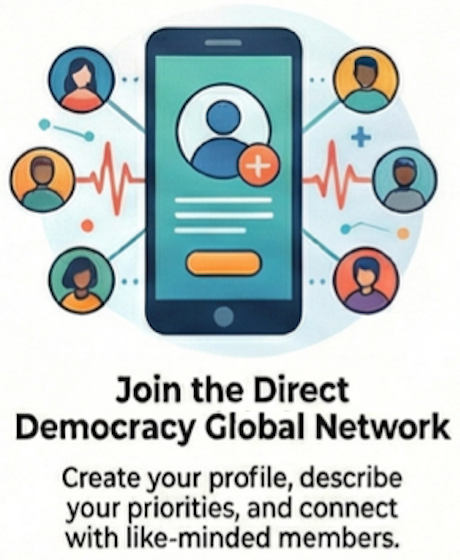
Step 1. Join the Direct Democracy Global Network
Welcome to the network! You can join free of charge by creating your home page and profile by entering your sign-in username and password.
As a network member, you can use its direct democracy information and messaging tools and services, free of charge, to connect to like-minded voters. You can define and share your priorities and legislative agendas, and collaborate to enact your agendas.
You can join forces to create online political parties, voting blocs, and electoral coalitions. You can build consensus across partisan lines to set common legislative agendas, bridge divides, and determine who runs for office, who gets elected, and what laws are passed.
Network services include conducting initiatives and referendums, as the Swiss have been doing for centuries. You can access to the network's Fact Checker and Voting Utility to cast votes on a variety of proposals.
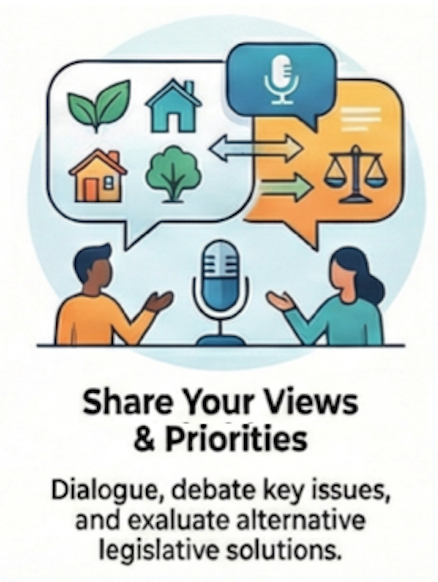
Step 2. Share Your Views and Priorities
Express your views, define your priorities, and create your own legislative agendas.
Save your priorities and agendas, and share them selectively, privately, and confidentially with individuals and groups you choose. Below are four methods.
(1) Describe any number of priorities in your own words, and set your own legislative agendas.
(2) Search the network priorities database listing priorities from a range of sources, and access web links to information about them. Select those that are similar to your own priorities, and what you want to happen legislatively.
(3) View priorities and agendas of individual network members who agree to share them, and select those you prefer. Names are not provided.
(4) Choose your legislative priorities and agendas from those of political parties, voting blocs, and electoral coalitions hosted on the network that agree to share them.
Step 3. Build Consensus and Set Common Agendas
In addition to defining your own priorities and setting your own agendas, you can connect to other network members to set common legislative agendas including priorities you share.
You can actively participate in collective efforts to build consensus across partisanlines. You can conduct online dialogues and debates, and reconcile divergent perspectives and objectives.
During your participation, you can clarify the meaning of your priorities and show how they resemble and/or diverge from other participants’ priorities. You can use the network’s Fact Checker to distinguish facts from misinformation.
You and other network participants can decide, at any point in time, to update and vote online to determine which priorities to include in common legislative agendas, using the network’s Voting Utility.
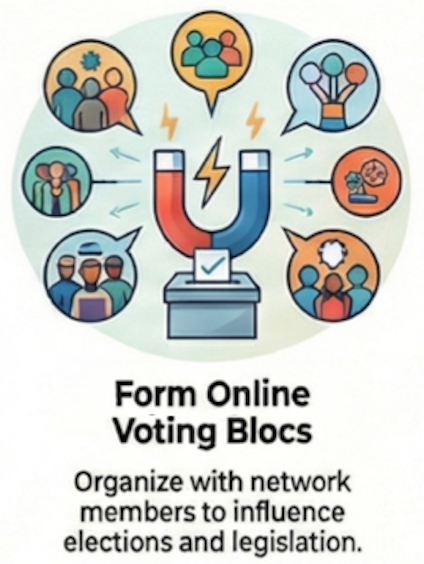
Step 4. Form Online Voting Blocs
You can collaborate with like-minded network members who espouse legislative priorities similar to yours, to take advantage of the network’s political organizing tools.
You can transform your personal networks into voting blocs and host and co-manage them on the network. Together you can utilize the network’s direct democracy tools and services to carry out tasks that are vital to fully functioning democracies.
Your blocs can function uniquely online within the network, or operate outside the network in locations and forms chosen by the members. They can choose to join existing blocs, parties, and coalitions, online and offline, and/or opt to work independently.
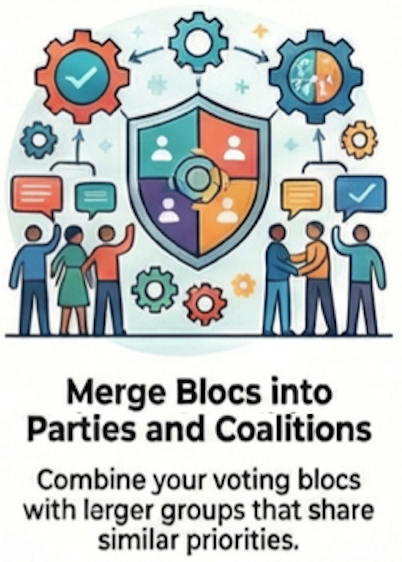
Step 5. Merge Blocs into Parties and Coalitions
You can merge your voting blocs hosted on the network with political parties and coalitions also hosted on the network, so they can build consensus across partisan lines and increase numbers of voters in their electoral base.
You can also decide to form your own political parties and electoral coalitions.
They can be organized informally, and create temporary ad hoc alliances with other parties.
In addition, you can organize them formally and register them officially with local governmental election agencies, to enable them to fully participate in electoral processes throughout election cycles.
Since their members can freely define their priorities and set their legislative agendas without regard to doctrines or ideogies, they can function autonomously and adhere exclusively to the decisions of their members.
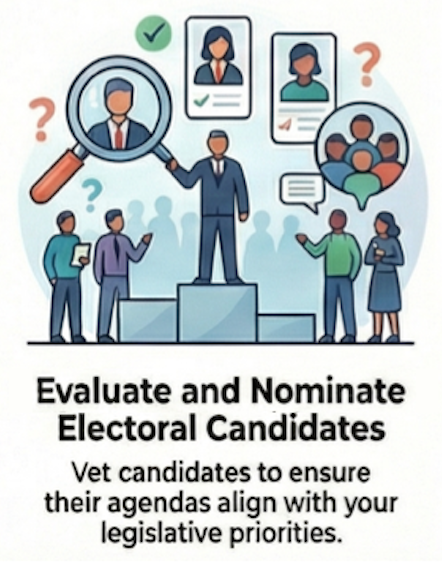
Step 6. Evaluate and Nominate Electoral Candidates
Thanks to the beneficial reversal of traditional practices, you and network voters can use the Direct Democracy Global Network to evaluate and nominate electoral candidates of your choice, rather than be limited to choosing among candidates already on the ballot.
You can collaborate with network members to identify and evaluate prospective candidates in depth, according to criteria of their choosing.
You can scrutinize candidates' prior activities, votes, and priorities to evaluate whether they align with your own priorities, and those of your voting blocs, political parties, and electoral coalitions.
In addition, you can conduct online interviews with prospective candidate, and evaluate first hand whether they appear likely to be consensus-builders if elected, and whether they will reach across partisan divides to prevent stalemates.
Step 7. Place Your Candidates on the Ballot
Laws, rules, and regulations for placing candidates on election ballots vary widely. They can be quite cumbersome, and require close and continuous scrutiny.
These complications can result from deliberate efforts to obstruct competitive electoral races by keeping voters from having fair chances to elect candidates of their choice.
Fortunately, there will be large numbers of election experts who are members of the Direct Democracy Global Network who will share their expertise with you and other members to ensure free and fair elections.
One of the most important steps is plan ning ahead and constantly monitoring changes in official election laws, regulations, procedures, to ensure you and network members, and your voting blocs, political parties, and electoral coalitions, are able to get your candidates' names on official primary ballots.
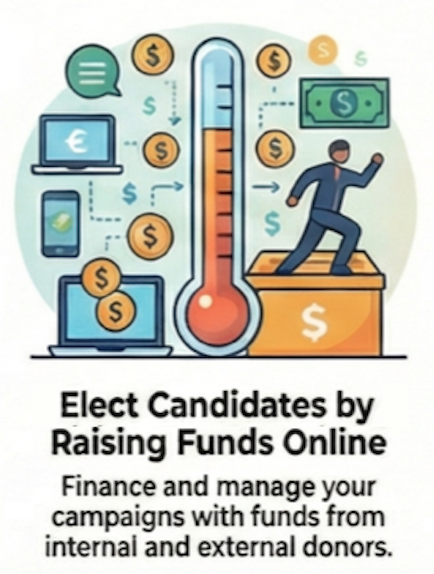
Step 8. Elect Candidates by Raising Funds Online
A strategically important key to winning elections is to raise funds to finance your campaigns that enable you to reach out to as many voters as you can. You can seek funding from sources inside and outside the network.
Billions of dollars are raised and spent during every election cycle. There are a variety of channels of communication that you can use to direct such funds to your campaigns.
The success of your fundraising efforts might be facilitated if prospective donors are informed of your membership in the Direct Democracy Global Network.
Increasing numbers of politically engaged individuals, groups, and organizations are devoting their time, energy, and donations to strengthening and re-invigorating democratic electoral and legislative processes and institutions.
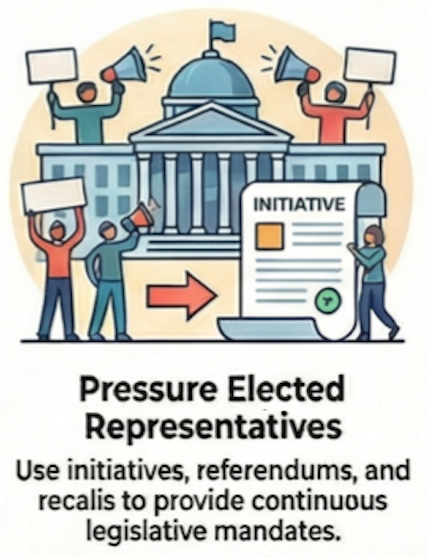
Step 9. Pressure Elected Representatives
You and the network members of your political parties, voting blocs, and electoral coalitions can actively participate in post-election decision-making in all branches of government, by using direct democracy tools provided by the network.
You can conduct petition drives, referendums, initiatives, and recall votes, publicize the results, and use them to transmit written mandates to decision-makers during all phases of governmental decision-making processes.
These mandates will reflect the needs and demands of the public and their constituents during all phases of post-election decision-making.
Your capabilities and those of network members to determine the outcomes of past and future elections will prompt decision-makers to heed your demands.
Step 10. Forge Cross-National Coalitions
You can join with network members to design and implement life-preserving policies and plans, such as curbing climate disruption, and collectively devising common peace-making plans worldwide.
By connecting online with network members and voters where you live, as well as across nation-state frontiers, you can collaborate to design and enact peace-making plans to resolve confrontations and conflicts worldwide. Voters living in different countries often experience similar needs, crises, and emergencies, even though their governments may tend to disagree.
You can use the network to connect to voters with experiences similar to yours. Network tools enable you to collectively create online political parties, voting blocs, and electoral coalitions dedicated to peace-making.
You can use network agenda-setting, political organizing, and electoral tools to create common fronts to induce lawmakers to enact common peace-making plans, within and across frontiers.
Collective Intelligence and the Global Brain: Bridging Partisan Divides Worldwide
In 1982, British intellectual Peter Russell published an unusual book. He was a University of Cambridge graduate in theoretical physics, experimental psychology, and computer science, and his book was entitled The Global Brain. Few people at the time grasped the meaning of the book's title, or the future impact of the connections Russell foresaw between technology and people. I had the pleasure of meeting Russell at that time, but I did not realize how prophetic his concepts would prove to be.
Many years later, informed proponents of the global brain hypothesis assert the following:
"The Internet increasingly ties its users together into a single information processing system that functions as part of the collective nervous system of the planet"
"The global brain is a neuroscience-inspired and futurological vision of the planetary information and communications technology network that interconnects all humans and their technological artifacts. As this network stores ever more information, takes over ever more functions of coordination and communication from traditional organizations, and becomes increasingly intelligent, it increasingly plays the role of a brain for the planet Earth."
This is reassuring news in the face of increasing divisiveness and polarization that is preventing once robust democracies from taking actions needed to protect people's lives and ensure bright futures.
It is also reassuring that experts at prestigious academic institutions, such as the Massachusetts Institute of Technology (MIT), followed Russell’s conceptual lead and created organizations dedicated to taking advantage of the possibilities Russell described: "The MIT Center for Collective Intelligence explores how people and computers can be connected so that—collectively—they act more intelligently than any person, group, or computer has ever done before."
One of the Center's research scientists, Mark Klein, addresses cogently the challenges facing us:
"Humanity now finds itself faced with pressing and highly complex problems – such as climate change, the spread of disease, international and economic insecurity, and so on - that call upon us to deliberate together at unprecedented scale, incorporating the input of large numbers of experts and stakeholders in order to find and agree upon the best solutions to adopt."
"While the Internet now provides the cheap, capable, and ubiquitous communication infrastructure needed to enable crowd-scale deliberation, current technologies (i.e. social media tools such as email, forums, social networks, and so on) fare very poorly when applied to complex and contentious problems, producing toxic inefficient processes and highly sub-optimal outcomes."
On the personal front, I had the pleasure of getting to know Klein and his work years ago, which I found to be inspirational with respect to my own work in developing the Direct Democracy Global Network. I especially appreciate this statement of his goals:
"My research mission is to develop technology that helps large numbers of people work together more effectively to solve difficult real-world challenges. It seems that many of our most critical collective decisions have results (e.g. in terms of climate, economic prosperity, and social stability) that none of us individually want, suggesting that our current collective decision-making processes are deeply flawed. I'd like to contribute to fixing that problem."
"My approach in inherently multi-disciplinary, drawing from artificial intelligence, collective intelligence, data science, operations research, complex systems science, economics, management science, and human-computer interaction, amongst other fields."
Whew! I find it immensely encouraging that forward-looking members of the world's scientific community are focused on researching and resolving technologically the global challenges I've described in the preceding sections.
Truth-Telling-Technology and Large Scale consensus-building
Many of us are familiar with reports of the negative impact of social media misinformation that can be generated by Artificial Intelligence (AI) and biased and divisive algorithms. However, astute analysts, especially Oxford University's Polonski, dismiss this bad news and replace it with good news, by emphasizing the positive impact technology can and will play.
"It is easy to blame AI technology for the world’s wrongs (or for lost elections), but there’s the rub: the underlying technology is not inherently harmful in itself. The same algorithmic tools used to mislead, misinform and confuse can be repurposed to support democracy and increase civic engagement. After all, human-centred AI in politics needs to work for the people with solutions that serve the electorate."
"There are many examples of how AI can enhance election campaigns in ethical ways. For example, we can program political bots to step in when people share articles that contain known misinformation. We can deploy micro-targeting campaigns that help to educate voters on a variety of political issues and enable them to make up their own minds. And most importantly, we can use AI to listen more carefully to what people have to say and make sure their voices are being clearly heard by their elected representatives."
Fortunately, the unbiased AI algorithms and fact-checking technology of the Direct Democracy Global Network is designed to enable voters to devise compromises and bridge partisan divides, especially those that cause legislative stalemates.
These findings enable me to conclude this essay on a positive note. They also encourage me to again draw attention to my own work and invention of political consensus-building technology, which have generated core premises of the Direct Democracy Global Network.
To summarize in closing, the network empowers voters to re-invent democracy by applying and adapting Swiss-inspired direct democracy tools to build consensus across partisan lines, within their home countries and cross-nationally. They can access the network free of charge and build large scale online voting blocs, political parties, and electoral coalitions with sufficient voting strength to defeat and replace unresponsive lawmakers.
Mainstream voters whose critical thinking capabilities and centrist-oriented political views remain unaffected by social media disinformation, can connect online 24//7 to build consensus across partisan lines.
Voters can create cross-partisan electoral majorities, and circumvent Minority Rule political parties, candidates, lawmakers and governments that enable partisan minorities to ignore and overrule popular majorities, and even prevent their emergence.
By joining the Direct Democracy Global Network when it becomes fully operational, they can apply lessons they have been learning for centuries: Voters hold the keys to the future. Yes, the best is yet to come!
Swiss Federal Department of Foreign Affairs (FDFA)
"Direct democracy is one of the special features of the Swiss political system. It allows the electorate to express their opinion on decisions taken by the Swiss Parliament and to propose amendments to the Federal Constitution. It is underpinned by two instruments: initiatives and referendums.
"In Switzerland the people play a large part in the decision-making process at all political levels. All Swiss citizens aged 18 and over have the right to vote in elections and on specific issues. The Swiss electorate are called on approximately four times a year to vote on an average of fifteen such issues.
"Citizens are also able to propose votes on specific issues themselves. This can be done via an initiative, an optional referendum, or a mandatory referendum. These three instruments form the core of direct democracy."
Popular initiative
"The popular initiative allows citizens to propose an amendment or addition to the Constitution. It acts to drive or relaunch political debate on a specific issue. For such an initiative to come about, the signatures of 100,000 voters who support the proposal must be collected within 18 months. The authorities sometimes respond to an initiative with a direct counter-proposal in the hope that a majority of the people and the cantons support that instead."
Optional referendum
"Federal acts and other enactments of the Federal Assembly are subject to optional referendums. These allow citizens to demand that approved bills are put to a nationwide vote. In order to bring about a national referendum, 50,000 valid signatures must be collected within 100 days of publication of the new legislation."
Mandatory referendum
"All constitutional amendments approved by Parliament are subject to a mandatory referendum, i.e. they must be put to a nationwide popular vote. The electorate are also required to approve Swiss membership of specific international organisations."
Swiss Confederation: Political System
"Switzerland is governed under a federal system at three levels: the Confederation, the cantons and the communes. Thanks to direct democracy, citizens can have their say directly on decisions at all political levels. This wide range of opportunities for democratic participation plays a vital role in a country as geographically, culturally and linguistically varied as Switzerland."
"Since becoming a federal state in 1848, Switzerland has expanded the opportunities it provides for democratic participation. Various instruments are used to include minorities as much as possible — a vital political feature in a country with a range of languages and cultures. The country’s federal structure keeps the political process as close as possible to Swiss citizens. Of the three levels, the communes are the closest to the people, and are granted as many powers as possible. Powers are delegated upwards to the cantons and the Confederation only when this is necessary."
Copyright © 2026 Direct Democracy Global Network
All Rights Reserved